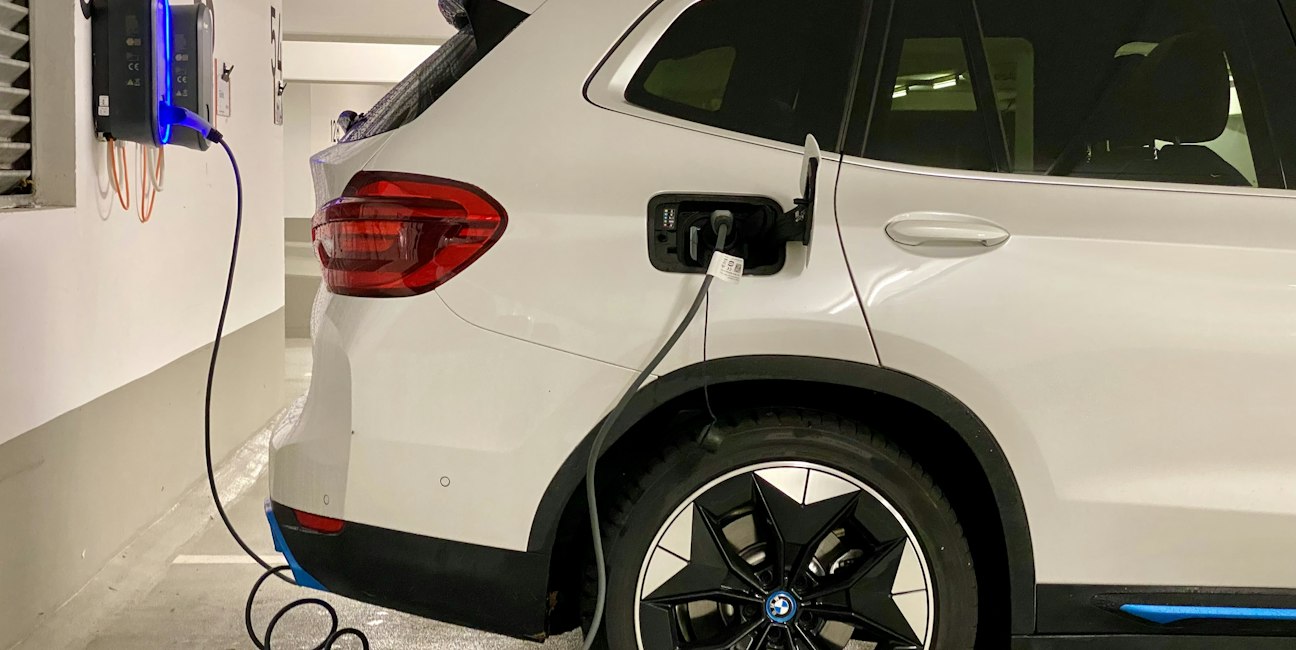
The EU wants three things from its car industry at once. It wants a softened version of the 2035 combustion-engine phase-out, shelter from Chinese imports, and cars people can afford. A new policy brief from Bruegel argues these goals collide, and that Brussels is leaning toward protection when it should be helping carmakers adapt.
The paper, “The European Union’s automotive sector needs a plan, not undue protection” (Policy Brief 19/2026, published 22 September), is written by Benjamin Bjerkan-Wade, Ignacio García Bercero, Antoine Mathieu Collin, Ben McWilliams and Simone Tagliapietra. It was supported by the European Climate Foundation.
The numbers are grim on volume. EU passenger car production has fallen by around 2.6 million units since 2019, a 19% drop. Europeans bought 2.2 million fewer new cars in 2025 than in 2019, and the brief says it is unclear whether that is temporary or structural.
But the industry is not broken. In 2025 the EU exported €157 billion of vehicles and imported €75 billion, a surplus of €82 billion. Carmakers posted some of the highest margins among major producing regions. More than €76 billion has flowed into battery and electric-vehicle factories since 2017, and about €3 billion a quarter still does. The sector employs 14 million people across its value chain, 6% of all jobs in the EU. Bruegel’s reading is that the risk lies in slowly losing export markets, technology leadership and supplier networks.
Chinese-built electric cars passed 20% of EU electric-car sales in 2026, more than 5% of all vehicle sales. More than half of them are western-branded cars made in China. EU duties of 7.8% to 35.3% on Chinese-made electric cars cover battery models but not plug-in hybrids. Battery imports have flattened. Plug-in hybrid imports have grown fast.
That undercuts the shield and pushes buyers toward more polluting cars, the authors say. They want protection equalised, either through a negotiated deal with China or a safeguard investigation. The brief notes that the EU made a first approach to Beijing this month about voluntary limits on Chinese hybrid exports.
The Industrial Accelerator Act, proposed in March, would add EU-origin content rules to subsidy schemes for electric cars, batteries and clean-tech parts, and set conditions on Chinese investment above €100 million. Bruegel says it comes without a clear view of what that costs per car.
Its own arithmetic: a binding EU-origin rule for battery cells would lift cell costs from about €50 to €85 per kWh. On a 60 kWh battery, that is roughly €2,100 per car. Low-carbon steel requirements add around €200. Set that against the Commission’s estimate that simpler type approval saves manufacturers about €61 per vehicle. The authors add that costs stack up and fall hardest on entry-level models, where buyers are most price-sensitive.
France offers a warning. Its subsidy scheme, which in practice has excluded Chinese carmakers, cut sales of excluded models by 60% relative to eligible ones. The brief cites research suggesting it may have lowered overall electric-car uptake by 0.9%.
The authors call for “an adjustment strategy rather than a shield against change.” At home that means a consolidated map of automotive regulation, no local-content rules without a cost-benefit test and a sunset clause, and more spending on the basics: energy costs, skills, charging and a clear framework for autonomous driving. Foreign investment should be treated as a chance to catch up, judged case by case. The brief lists CATL’s €7.3 billion battery plant and BYD’s €4 billion car plant in Hungary among the large Chinese projects.
Abroad, it proposes a time-limited sectoral agreement with China. Chinese export quotas would cover both electric cars and plug-in hybrids, with a snapback if breached, alongside agreed principles on inward investment and a standstill on new EU trade-defence cases. The quotas would rise over time and expire on a set date. The EU-China trade and investment consultations, first held in June, are the natural forum. If talks fail, the authors say the EU should be ready for WTO-consistent safeguards.
This is not a free-trade manifesto. Bruegel accepts that quotas are legally shaky under WTO rules and can hand Chinese exporters extra profit. Its case is that any help should be temporary and tied to European carmakers closing the gap on affordable electric cars. For the Commission, the test is whether the Industrial Accelerator Act keeps local-content rules that, on Bruegel’s numbers, add more to a car’s price than the simplification package takes off.


.jpeg)