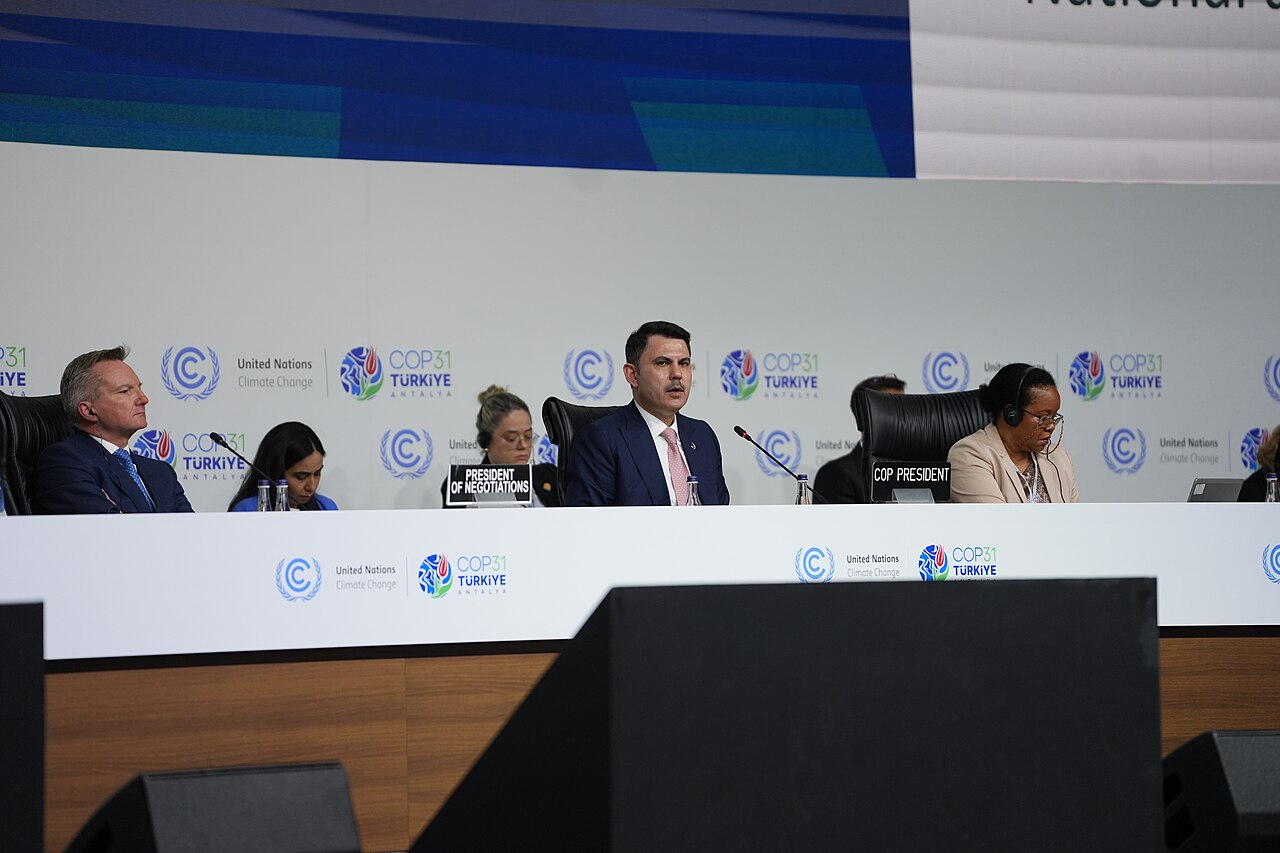
The EU has done something it almost never does at a climate summit: it said no and walked out. COP31 in Antalya, Turkey, ended on Sunday without an agreed decision after European ministers rejected a final text that left out any reference to fossil fuels. The talks had already run two days past their Friday deadline, making this the longest climate conference on record.
"We recognise that there is no consensus on this document. Therefore, these decisions have not been adopted," COP31 President Murat Kurum told the closing plenary. With that, nearly 200 countries went home with nothing.
The draft put forward by the Turkish presidency did not mention oil, gas or coal, which account for roughly three quarters of global emissions. It also promoted carbon capture and storage, a technology petrostates favour because it lets them keep pumping, and it softened language on climate science.
That was too much for Europe. A joint position backed by about 130 countries, calling for stronger wording on a transition away from fossil fuels, never made it into the final decision. At that point, said Wopke Hoekstra, the EU's climate commissioner, a deal was out of reach. "Frankly, it's backsliding," he said after the summit. "Occasionally you have to draw a line in the sand and say, no, the answer is no."
Ireland's climate minister Darragh O'Brien, speaking for the EU, told delegates the proposed pact amounted to greenwashing, then left the room with Hoekstra. Panama, Belize, Vanuatu and the Marshall Islands also objected. On the other side, Saudi Arabia and Russia refused any language linking fossil fuels to climate change.
The United States was not in the room. The Trump administration skipped COP for a second year running, but a French environment ministry official said Paris saw Washington's fingerprints on the outcome: an American stance that encourages oil producers to resist ambitious wording. US Commerce Secretary Howard Lutnick argued afterwards that the collapse reflected a broader breakdown in the climate consensus.
Because COP decisions are taken as one package by consensus, the walkout sank more than the fossil-fuel paragraph. The hosts had billed Antalya as the "electrification COP", with a pledge to lift electricity's share of global energy from around 23% to 35% by 2035. Dozens of countries had signed up. It did not survive. "Electrification was collateral damage when the whole decision cratered," said Alden Meyer of the E3G think tank.
So was money for the countries hit hardest. Elements that would have delivered on tripling adaptation finance by 2035 sat inside the rejected decision. The UN estimates that developing countries' adaptation needs will reach $305bn a year by 2035. Of the $1.3tn a year rich nations agreed in 2024 to eventually mobilise, about $136.7bn was delivered that year, according to the OECD.
Brussels would like this to be a simple story about principle. It is not. Climate Action Network Europe argues the EU bears "significant responsibility" for the meltdown because it arrived focused on what it would not accept on climate finance, rather than on offers that could unlock a deal. "From the beginning, the EU came to Antalya with a strategy built only around red lines, and that strategy cannot succeed," said Chiara Martinelli, the network's director.
That matters because the alliance between Europe and climate-vulnerable countries is what held the Paris Agreement together during Trump's first term. This time it frayed. The EU also had less moral authority than before: at home, the Commission's "simplification" drive is rolling back parts of the climate legislation adopted during Ursula von der Leyen's first mandate.
The setting did not help either. The summit opened barely two months after a UN report conceded that the 1.5C goal is effectively lost, and it ran under the shadow of the Iran war energy crisis. European gas prices jumped again this week on a colder weather outlook.
Hoekstra is already pointing elsewhere. "The reality is that we will have to do more with plurilateral initiatives," he said. "You simply cannot put all your eggs in one basket." The obvious vehicle is the group of more than 50 countries that held a first conference on transitioning away from fossil fuels in Colombia in April. Ireland and Tuvalu will co-host the second in 2027.
The unfinished UN work now moves to the Bonn intersessional talks, with the next COP due in Addis Ababa in a year. Australia's Chris Bowen, who ran the negotiations, insisted the energy shift will happen regardless. "The transition away from fossil fuels in the real world is inevitable," he said. "It's happening at speed and it's irreversible."
It is not the first time a COP has ended in a row. The Hague in 2000 and Copenhagen in 2009 both broke down, and the process recovered. But those failures came with Washington inside the tent. This one came with the US actively hostile from outside.
The EU kept its red line and lost the room. Walking out protected the fossil-fuel language agreed in Dubai in 2023 from being quietly buried, which is a real win for Brussels. But it also left Europe isolated from the vulnerable countries it needs as allies, and it handed petrostates and Washington the story that UN climate diplomacy no longer works. Expect the EU's energy to shift to smaller clubs of like-minded countries. That can move faster than a 200-nation consensus. It also means the countries most exposed to climate damage, and least able to pay for it, are more likely to be left out of the deals that matter.