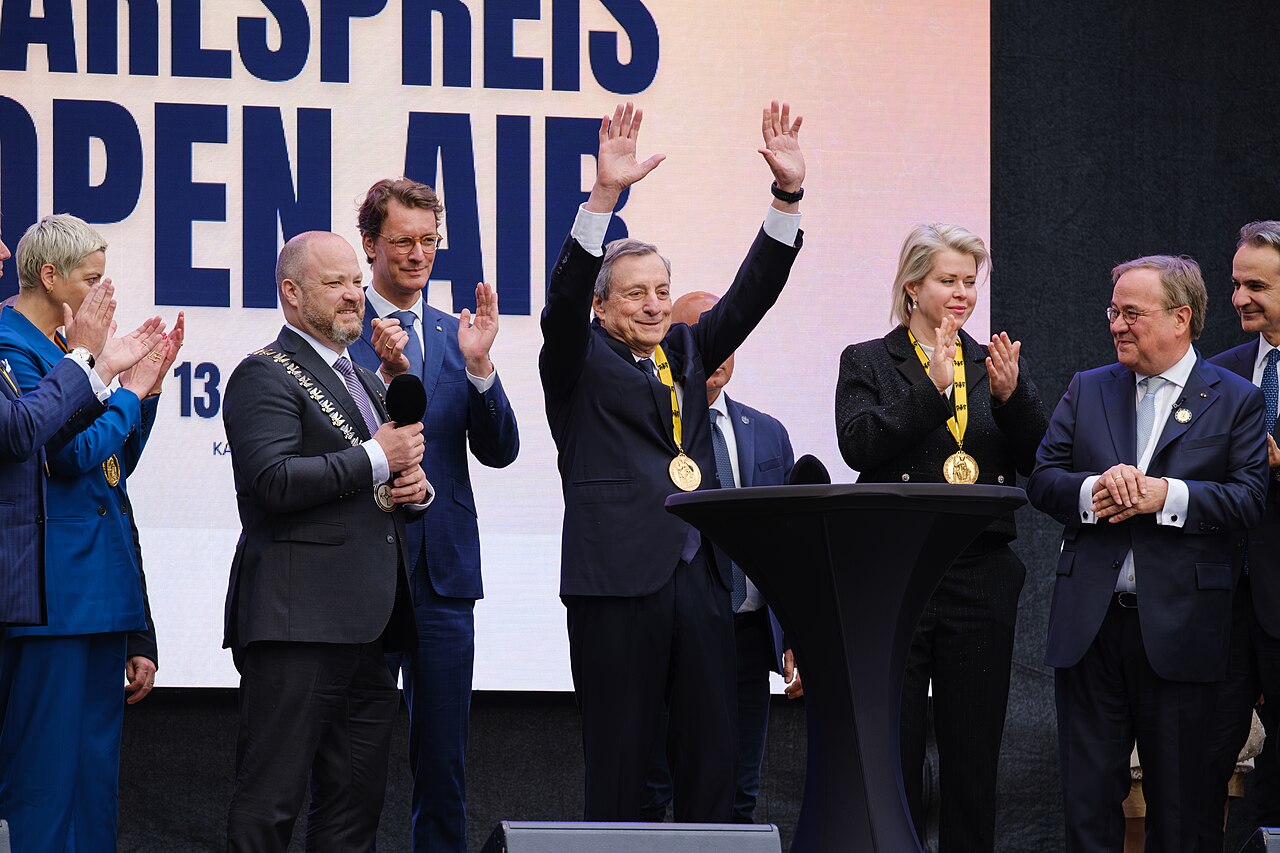
Mario Draghi doesn’t do understatement. Accepting the Charlemagne Prize in Aachen on Thursday, the former ECB president and Italian prime minister distilled Europe’s predicament into a single sentence: “For the first time in living memory, we are truly alone together.”
The speech covered familiar ground for anyone who read his 2024 competitiveness report. But the backdrop gave it a harder edge. Across the continent, energy costs remain elevated. In Beijing, Trump and Xi were simultaneously concluding a summit that reset key global trade relationships without a single EU representative in the room. Draghi’s abstract argument about European isolation had just been illustrated in real time.
Draghi’s case rests on a structural shift that European leaders have been slow to absorb. The US security guarantee that underwrote European prosperity since 1949 can no longer be taken as given. The trading relationships that generated growth have become more adversarial. The energy market that kept European industry competitive collapsed under geopolitical pressure and has not recovered. “The world that once helped Europe generate prosperity no longer exists,” Draghi said. “It has become harsher, more fragmented and more mercantilist.”
The part of the speech that landed hardest was his description of the EU’s institutional dysfunction. Europe announces ambitious plans and then delivers too little — and that gap, Draghi argued, is not a management problem. It is a legitimacy crisis. “Weakness in delivery erodes legitimacy, and weakness in legitimacy makes delivery even harder. We must break this cycle.” The pattern applies across energy, defence, capital markets, and digital policy: big frameworks, partial implementation, eroding credibility.
Friedrich Merz was also in Aachen, and he drew a different lesson from the same moment. The German chancellor wants a “Draghi-proof” EU budget — his phrase — meaning leaner, focused strictly on competitiveness and defence, and built without new common European debt. Germany’s constitution precludes it from backing shared EU borrowing, Merz said, and many heavily indebted member states are already spending more servicing their debt than funding their militaries.
The disagreement is not new, but it is sharpening. Draghi’s vision requires the kind of fiscal solidarity that northern and eastern European governments have resisted for decades. Merz’s vision keeps spending discipline intact but offers no convincing account of how Europe closes its investment gap against the US and China on that basis.
Analysts who study European integration note that the current moment differs from previous reform debates in one important way: the external pressure compelling change is more immediate and less deniable. Strategic autonomy from the United States, long a political slogan, has become a practical planning assumption for defence ministries and central banks alike. The question is whether that urgency is enough to move the fiscal argument — or whether Europe will keep announcing more than it delivers.
The Charlemagne ceremony in Aachen was a useful mirror. Draghi and Merz, standing a few metres apart, represent the two coherent positions available to European leaders right now: invest together at scale and accept the fiscal consequences, or do less collectively but do it with less debt. Neither path is costless. What Draghi’s speech made clear — and what the summit in Beijing underscored — is that the most expensive option of all is continuing to announce the first while actually doing the second.


.png)