Spain’s North African enclave of Ceuta spent this week preparing for a date set on social media. Posts circulating in Facebook groups named “Migration to Ceuta Inshallah” and “Moroccan migrants (Harraga Maroc)” — together counting more than 74,000 members — named Saturday 15 August as the moment for a second mass crossing. One post noted that 15 August is a public holiday in Spain and that the border post runs around the clock.
Spanish law enforcement took it seriously enough to write it up. A six-page assessment attributed to the Civil Guard, based on open-source intelligence, examined Facebook, WhatsApp and Instagram groups whose combined membership runs to well over 400,000 accounts and found consistent references to 15 August, alongside discussion of departure points and logistics. Raúl Díaz, a spokesman for the Spanish Interior Ministry, said the National Police and the Civil Guard were monitoring the platforms “to gather the necessary information to make appropriate decisions at any given time, based on the level of threat”.
The July surge was not spontaneous. On 30 and 31 July more than 72,000 people crossed from Morocco into Ceuta, most of them swimming around the breakwater at El Tarajal. It was the largest irregular crossing of an external European border ever recorded in a single spell. Around 80 people died, according to pathologists cited by Reuters. About 70,000 have since been returned to Morocco, the Spanish Interior Ministry says; roughly 5,000 remain in a city whose own population is 84,000.
What set it off was a misreading — deliberately amplified — of a Spanish Supreme Court ruling on 8 July. The ruling made it harder for Spanish authorities to summarily return Moroccan nationals who arrive in Ceuta by sea, on the grounds that no physical barrier demarcates that stretch of border. Online, the ruling was recast as something close to the old American “wet foot” policy: touch Spanish sand and you are safe. José María Gil Garre of Madrid’s International Security Observatory, who catalogued the campaign across WhatsApp groups, TikTok accounts and Facebook pages, found that traffic spiked in the days after the judgment became public. “You can swim into Ceuta, but you cannot leave Ceuta,” he said. Díaz called it a “self-serving interpretation” by smuggling networks.
Meta says it has a team monitoring Ceuta in real time and is removing content that offers or seeks human-smuggling services, with European fact-checking partners working on the misinformation. That is a familiar shape of problem for the EU: the crisis moves at the speed of a Facebook group, the response at the speed of a content-moderation policy.
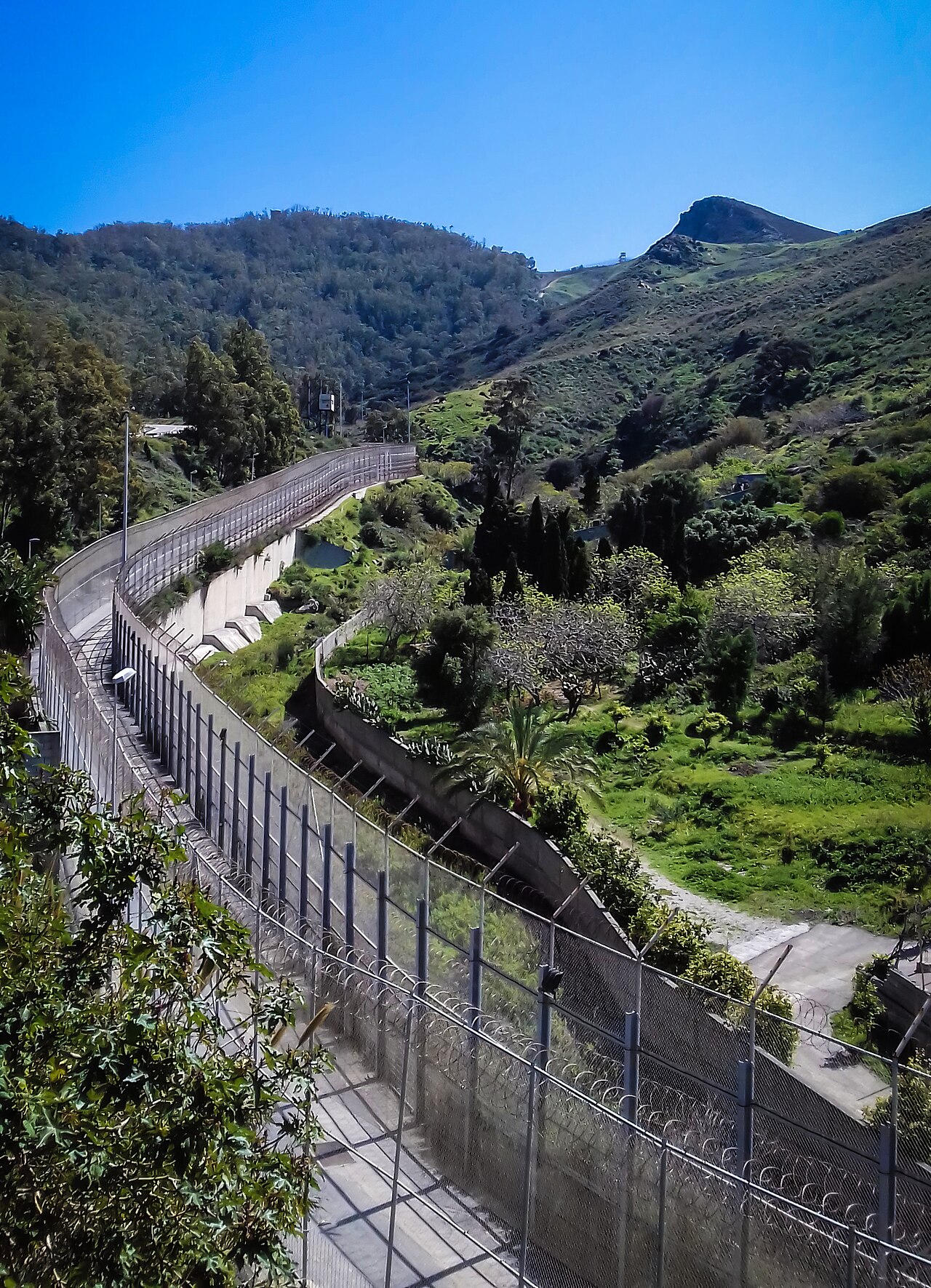
On the Moroccan side, Rabat has effectively militarised the approach to Ceuta. National Security, the Royal Gendarmerie and the Auxiliary Forces have been deployed around the frontier, with joint patrols on the roads leading in from Fnideq, checks on buses and taxis heading for the crossing, and sweeps of the woodland where people gather before attempting to cross. Barbed wire and metal posts have gone up along the coastal stretches used in July, with some barriers extended several metres into the water to stop swimmers. Moroccan authorities have called the online appeals “suspicious and misleading”, detained dozens of undocumented migrants, most of them from sub-Saharan Africa, and arrested several people accused of using social media to encourage illegal crossings. Rabat has also pressed Madrid to speed up the return of unaccompanied Moroccan minors who arrived in July.
Spain has around 1,600 police and Guardia Civil officers in Ceuta alongside military personnel, reinforced coastal surveillance and, after its intelligence services judged the latest campaign credible, prepared for a repeat. Interior Minister Fernando Grande-Marlaska has warned that anyone who reaches Ceuta will not be permitted to stay in Spain or travel on to the mainland.
Ceuta is an external border of the European Union, which makes this a Brussels problem whether or not Brussels wants it. Magnus Brunner, the European Commissioner for Internal Affairs and Migration, has offered Frontex support to reinforce surveillance, register arrivals and assist with returns, and has sketched a five-point response: closer work with countries of origin and transit, faster returns, a reinforced external border and a bigger role for Frontex, early-warning systems aimed specifically at disinformation, and pressure on smuggling networks through sanctions and international cooperation.
Money is the more immediate lever. Around €28 million has already been allocated to migration management in Ceuta, and the Commission confirmed in early August that talks with Madrid on additional support were running at full speed, following a first needs assessment from the Spanish authorities. That funding could cover border-management equipment and services as well as humanitarian and medical assistance. Frontex is not starting from scratch either: Operation Minerva, launched in June 2025 and coordinated by the Spanish National Police, already deploys officers from fifteen European countries across the Strait of Gibraltar, including Algeciras, Tarifa and Ceuta.
Behind all of it sits the Pact on Migration and Asylum, whose Asylum and Migration Management Regulation is supposed to turn solidarity from a political favour into a structured obligation. Member states agreed the first annual solidarity pool in December 2025, and Spain is among the countries designated as under migratory pressure. Ceuta is the first hard test of whether that machinery does anything when a member state actually asks.
Whatever happens at El Tarajal this weekend, the July surge already changed the terms of the argument. It showed that an EU external border can be overwhelmed in a day by a rumour, and that the tools designed for the problem — readmission arrangements with Morocco, Frontex deployments, emergency funding, a new solidarity mechanism — are all slower than the thing they are meant to counter. The heavy security presence on both sides may well keep Saturday quiet. But deterrence delivered by 1,600 officers and rolls of concertina wire is a holding operation, not a policy. The harder questions — what the EU owes a member state whose border is 14 kilometres of fence and open water, and how it responds when the trigger is a viral post rather than a smuggling boat — are the ones Brussels has spent this summer discovering it has not answered.