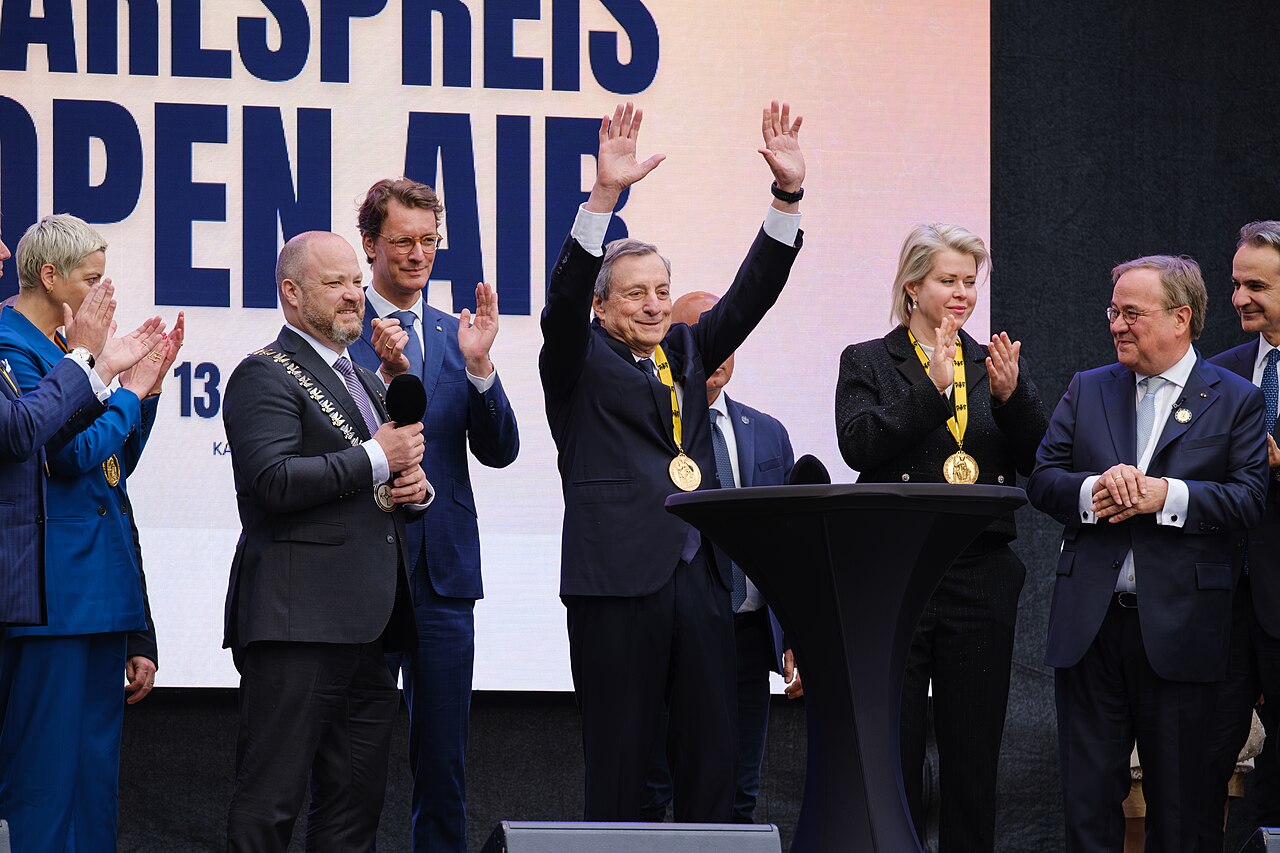
Albin Kurti has a government again. Kosovo's parliament confirmed his fourth cabinet on 13 September with 62 votes in the 120-seat chamber, ending three months without an executive and, by some counts, eighteen months of institutional chaos. His stated first priority is the one thing Kosovo has never had: European Union candidate status. "The main objective and the top strategic priority," he called it.
EPIC's Integration Readiness Index suggests the priority is not unreasonable. On the index's own terms, Kosovo is already more ready than three countries that hold the status it is asking for.
The Integration Readiness Index (readinessindex.eu) is a June 2026 study by EPIC, the European Policy Innovation Council, co-published with the Friedrich Naumann Foundation and authored by Antonios Nestoras, Emil Kirjas and Bernada Cunj. It scores ten applicant countries from 0 to 10 for each year from 2021 to 2025, using only the European Commission's own annual progress reports as source material. Five indicators feed the score: the state of play in each policy area, annual progress, delivery on the Commission's recommendations, the status of negotiating chapters, and accession momentum. The benchmark is Croatia in 2011, the last country to complete the process.
The 2025 field reads: Montenegro 6.8, Albania 6.7, Moldova 5.87, Ukraine 5.85, Serbia 5.5, North Macedonia 5.5, Kosovo 3.61, Georgia 3.26, Bosnia and Herzegovina 2.91, Türkiye 2.81.
Kosovo's 3.61 is a low number. It is roughly half Montenegro's score and a long way from the Croatia-2011 finish line. But look at who sits below it. Georgia, a candidate since December 2023, scores 3.26 and has been sliding since 2023. Bosnia and Herzegovina, a candidate since December 2022, scores 2.91 after the steepest one-year drop in the index. Türkiye, a candidate since 1999, scores 2.81 and is less ready than it was in 2021.
All three have something Kosovo does not: the formal status of candidate country, granted by a unanimous Council decision. Kosovo applied in December 2022, the same month Bosnia was upgraded. Nearly four years later it remains a "potential candidate", a category it now occupies alone among the Western Balkan applicants.
The reason is not in the Commission's progress reports, which is precisely why the index cannot capture it. Five member states, Spain, Slovakia, Romania, Greece and Cyprus, do not recognise Kosovo's independence. Candidate status requires all 27. The index measures how a country performs against the criteria; it has no column for whether the club will let it apply.
That is the gap EPIC's numbers expose. For Albania, as EU Insider reported on 13 September, the index score runs ahead of the chapter count. For Kosovo, the index score runs ahead of the status itself. Kosovo is being scored on a process it has not been admitted to, and it is scoring better than three countries that have.
The score is not flattering, and the method explains why. Two of the five indicators, chapter status and accession momentum, reward movement through the negotiating framework. Kosovo has no framework to move through. A potential candidate with no screening, no opened chapters and no intergovernmental conference will score close to zero on those measures no matter how much domestic reform it delivers. The remaining three indicators, drawn from what the Commission writes about the rule of law, the economy and administrative capacity, are where Kosovo earns its points.
In other words, a part of the 3.61 is a measurement of Brussels rather than of Pristina. The same is true in reverse for Türkiye, whose 2.81 reflects a framework that exists on paper and has been frozen since 2018.
The Commission's own message to Pristina has been consistent: candidate status and the money attached to the Growth Plan for the Western Balkans depend on stable institutions. Kosovo has just spent a year and a half demonstrating the opposite. The June election was the third in two years. The new government passed with the Democratic Party of Kosovo and the Alliance boycotting the session and the Democratic League of Kosovo abstaining.
The next test is the presidency, which needs a two-thirds majority Kurti does not have. In late August he agreed with the Democratic League to back law professor Bekim Sejdiu; six of that party's eighteen MPs said the next day that they would not follow their leader. On 15 September Sejdiu withdrew. If parliament cannot elect a president, Kosovo goes to a fourth snap election in two years, and the government confirmed on Saturday becomes a caretaker again.
EPIC's index is built to answer one question: how far is each applicant from the Croatia-2011 finish line, judged by the Commission's own reporting. On that question Kosovo sits seventh of ten. The political question, whether the Council will even start the clock, is one the index deliberately does not ask, and it is the one that decides Kosovo's status. Kurti's government can move the first number by delivering reforms the Commission will record. It cannot move the second, which sits in Madrid, Bratislava, Bucharest, Athens and Nicosia. The Commission presents its Pre-Enlargement Policy Reviews on 30 September and its annual enlargement package in the autumn. Those documents will feed the 2026 edition of the index. They will not, on their own, make Kosovo a candidate.